
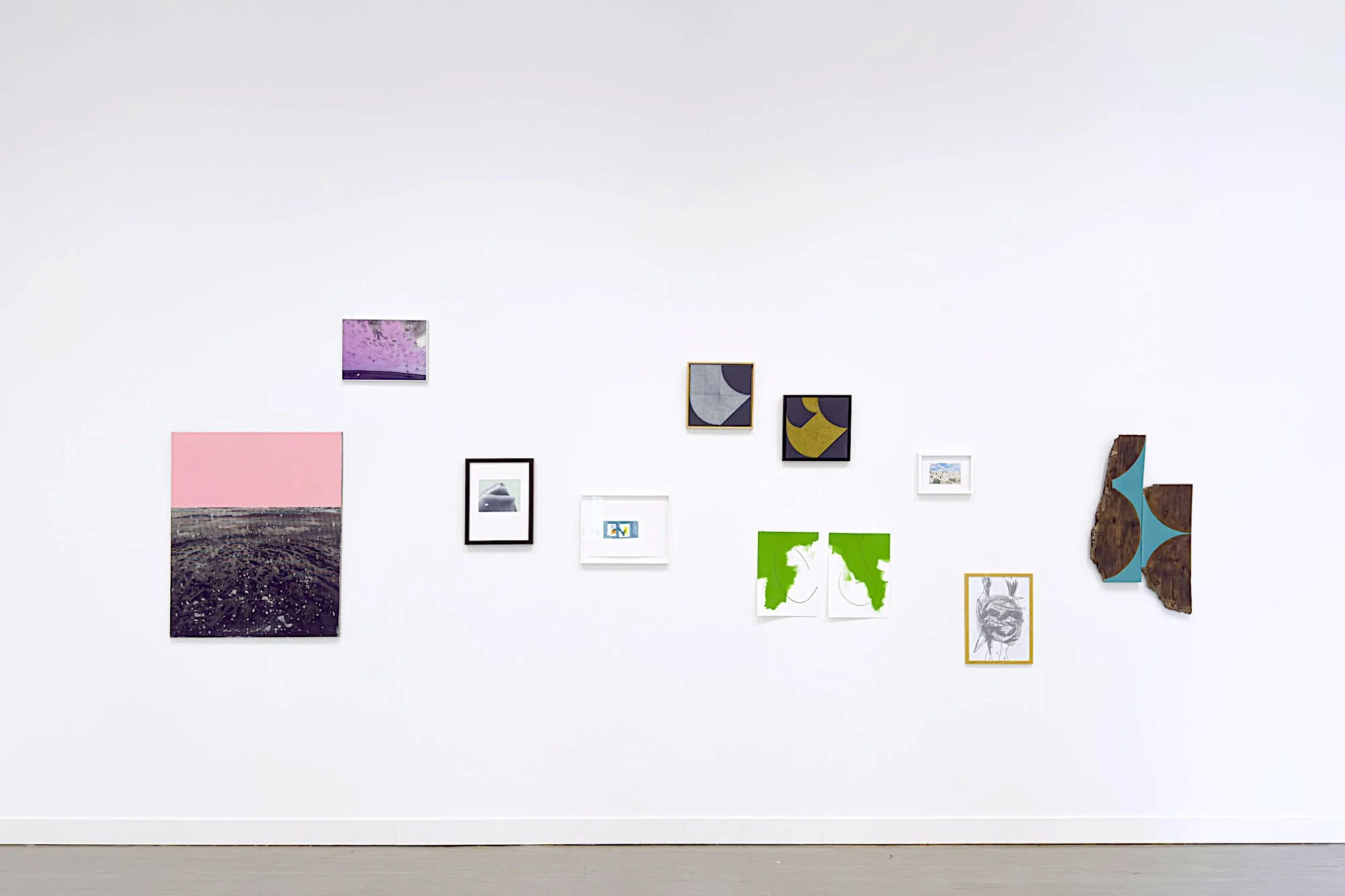
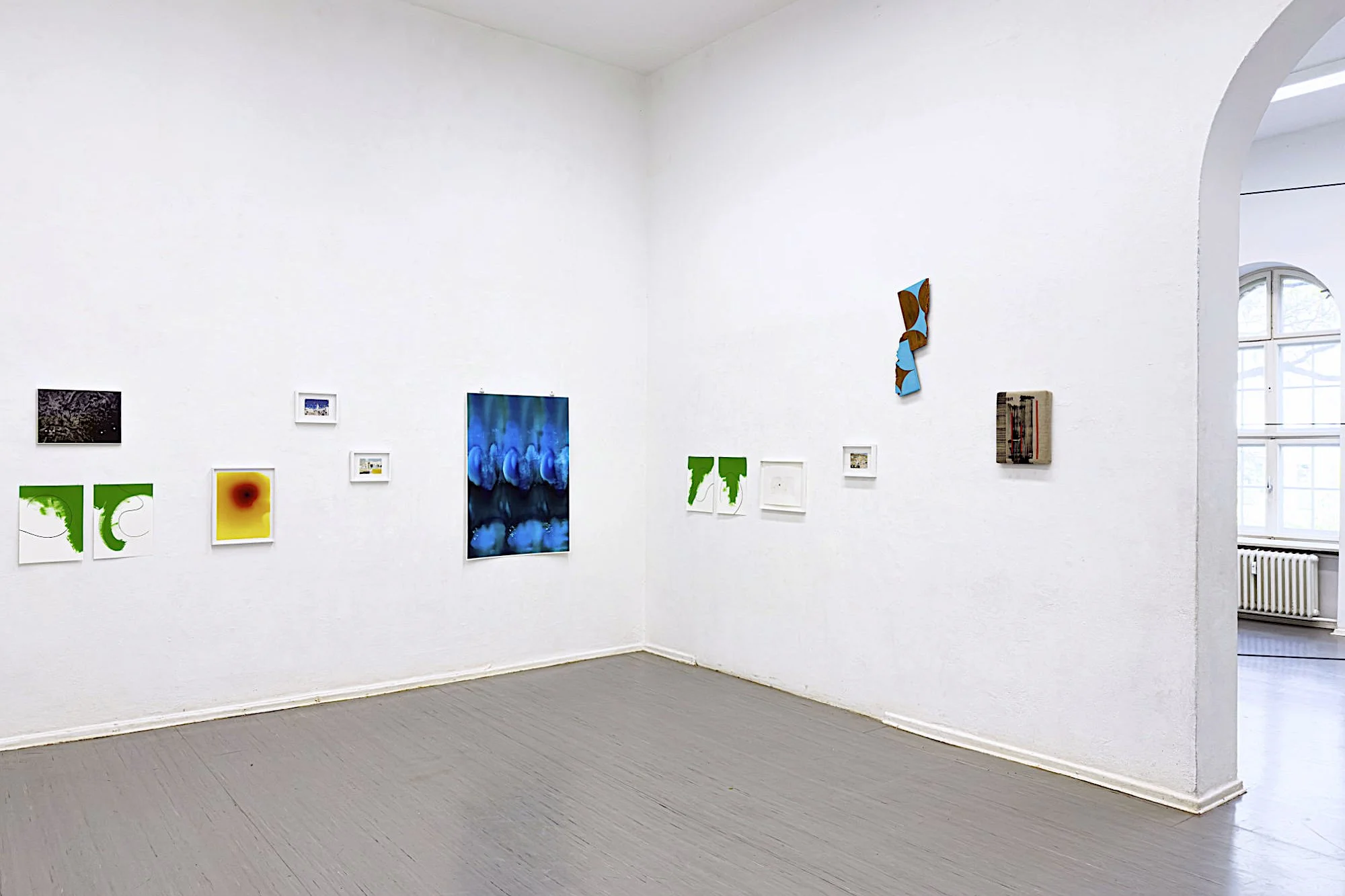
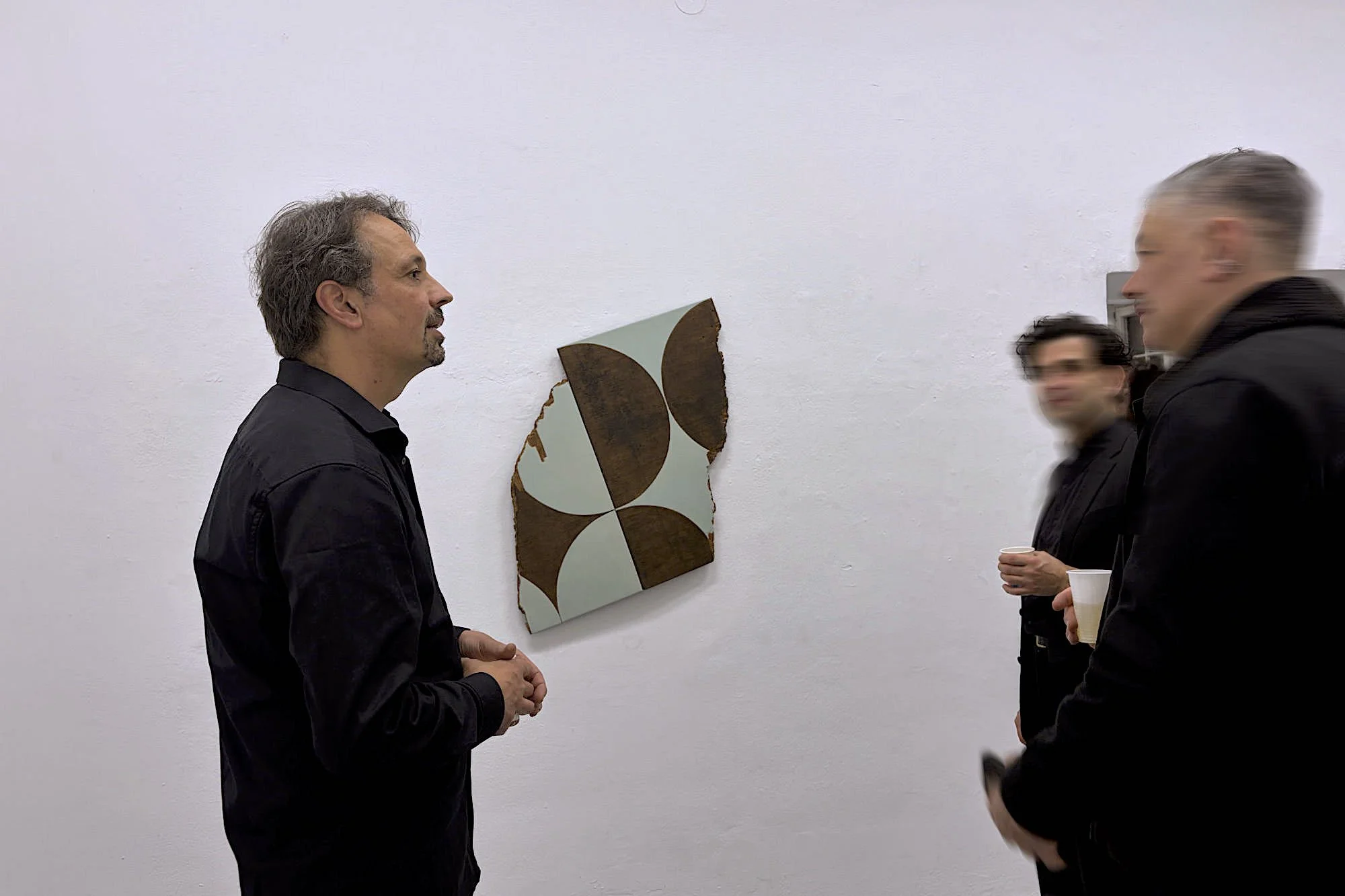
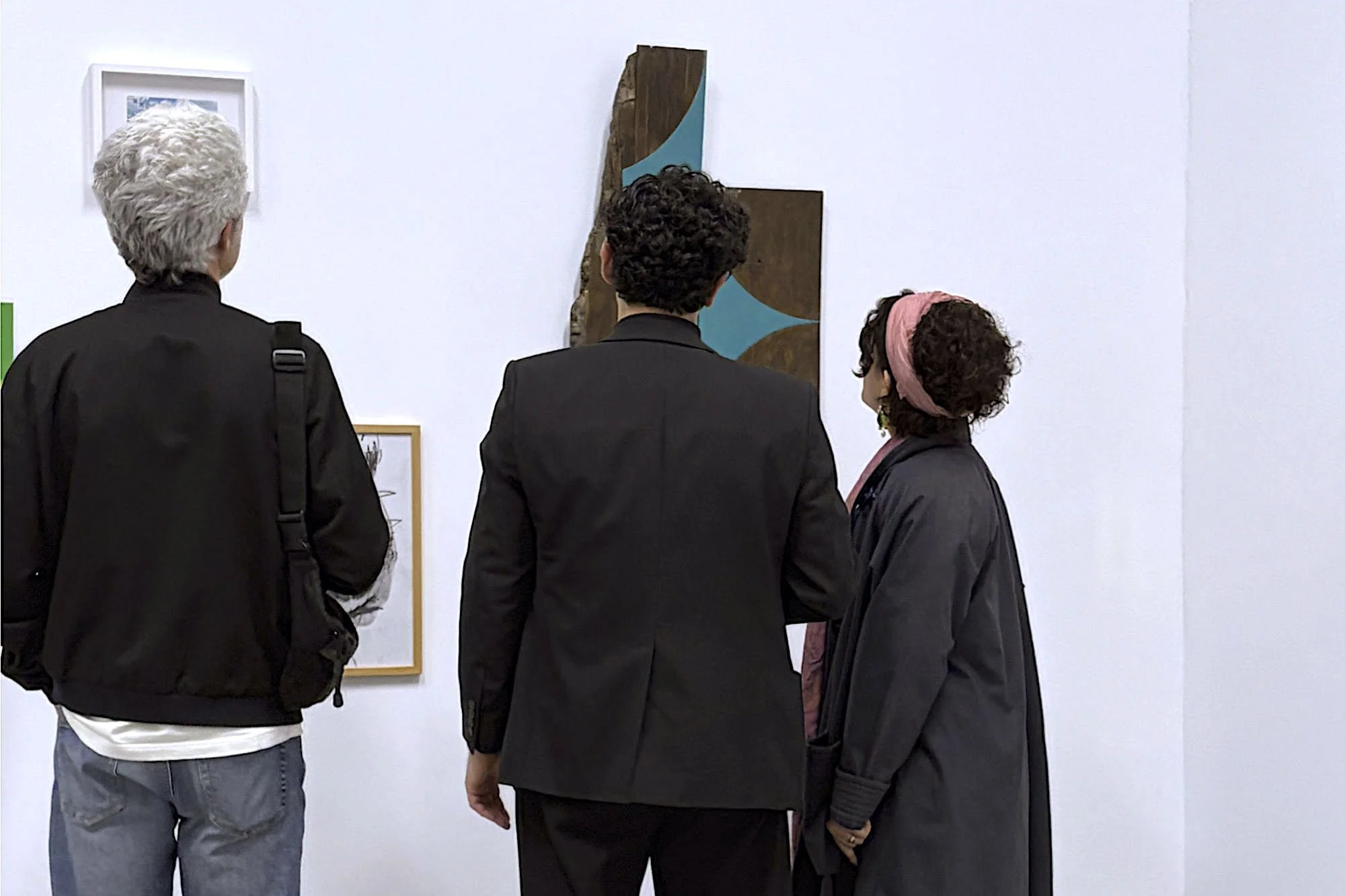
Kunstquartier Bethanien, Berlin
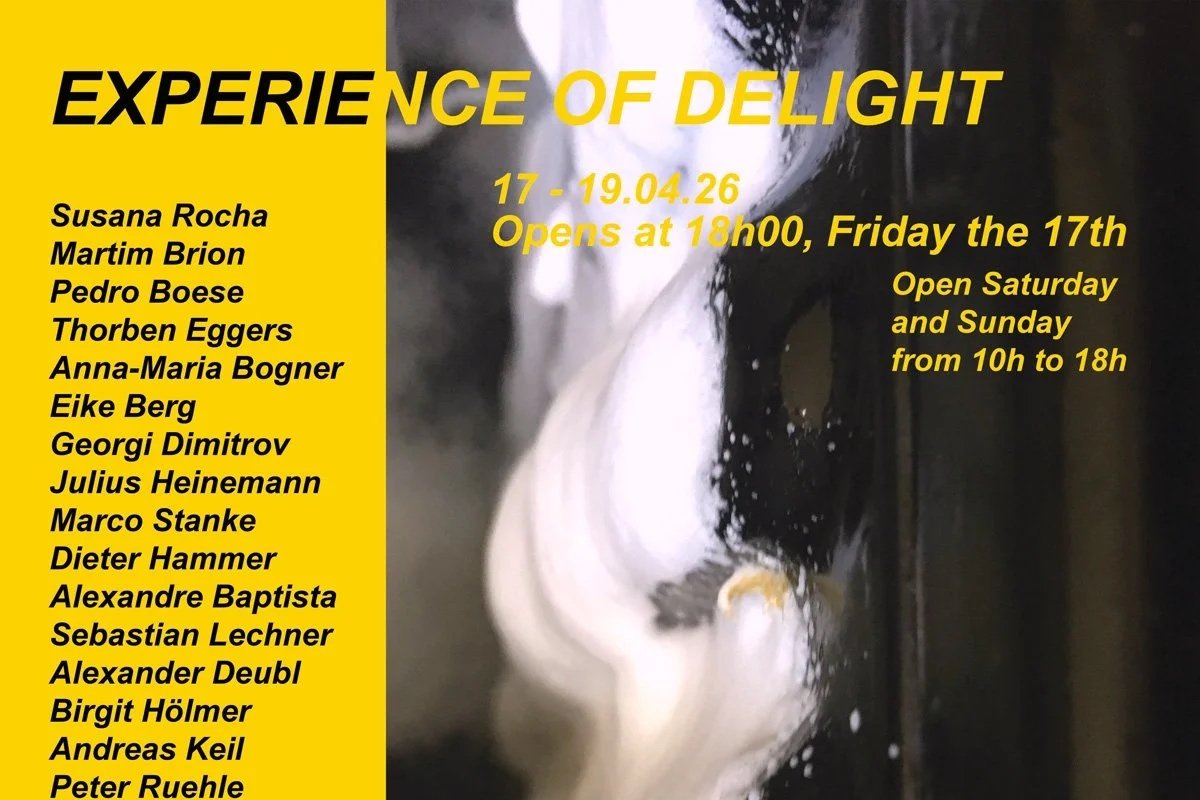
Opening: Friday 17th of April 6 pm
Duration: 17. - 19.04.2026
Participating artists: Susana Rocha, Martim Brion, Pedro Boese, Thorben Eggers, Anna-Maria Bogner, Eike Berg, Georgi Dimitrov, Julius Heinemann, Marco Stanke, Dieter Hammer, Alexandre Baptista, Sebastian Lechner, Alex Deubl, Birgit Hölmer, Andreas Keil, Peter Ruehle, Tomáz Hipólito, Lars Breuer, Marile Holzner, Daniel Hörner, Fiene Scharp, Annina Roescheisen, Marta Djourina
Curator: Martim Brion
Essay by Marina Slavova:
EXPERIENCE OF DELIGHT On dialogue, perception, and the freedom not to know
This is not a conventional exhibition text. Not an attempt to situate or explain the relationship between abstraction and figuration within art history. Perhaps also because we have grown somewhat tired of texts that tell us what to see before we have even begun looking. And perhaps because this is not about offering definitive readings in the first place.
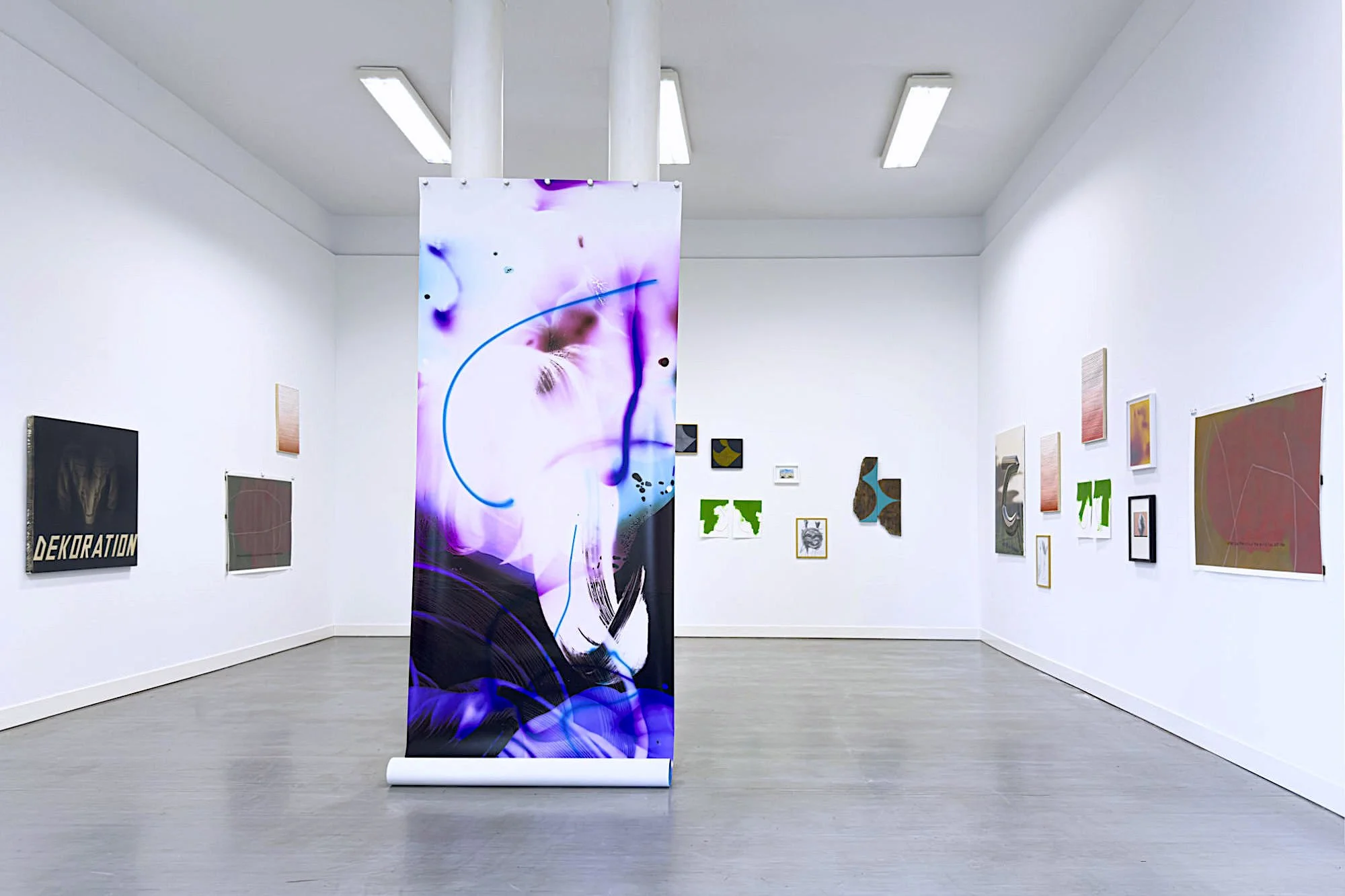
What this exhibition opens instead is a space of encounter. Different visual languages, artistic approaches, and modes of perception enter into relation with one another. These relations are not fixed, they remain fluid. They emerge between the works, shift with every step through the rooms, and continue within the perception of each visitor.
The Kunstquartier Bethanien provides a particular starting point for this. Its rooms do not structure the exhibition as a linear sequence, but as a series of situations. Each constellation unfolds its own dynamics, its own field of tension. One does not move along a clear argument, but rather through a web of references that gradually reveals itself in a spatial dialogue.
A dialogue not only between abstract and figurative visual languages – as central as this juxtaposition may be – but between different attitudes, ways of perceiving, and modes of thinking. Between works that draw closer or repel one another. Between artists who may never have met. And not least between the works and us as viewers.
In a present increasingly marked by polarization, where difference is often understood as opposition rather than possibility, this exhibition appears almost as a counter-model. It insists that differences do not necessarily have to be resolved. That friction is not a problem, but a point of departure.
The dialogues that emerge here are not linear conversations. They do not move from A to B. They circle, shift, begin again. Sometimes connections appear only on a second look. Or not at all.
This becomes particularly visible in the juxtaposition of figuration and abstraction. Two terms often conceived as dichotomous opposites: the recognizable, the legible, bound to the visible world, and the open, the withdrawn, that which resists direct naming. And yet this distinction may be less stable than it seems.
For even the seemingly figurative remains fragmentary, ambiguous, dependent on our gaze. And the abstract is never free of references – it activates memories, associations, bodily sensations. It addresses us, often before we understand why.
In this sense, the history of abstraction – from the avant-gardes of the late nineteenth and early twentieth centuries to the present – can also be read as a shift in focus: away from the depiction of the external world, toward inner images, psychological states, subjective orders. The Dadaist and other early avant-garde movements did not emerge by chance alongside the upheavals in psychoanalysis, but in a moment when attention was increasingly turning away from the visible and inward, toward unconscious imagery and fragmented realities. Art becomes a site where perception condenses, where something is revealed that cannot be immediately named.
Seen this way, every act of looking is also a process of self-observation. What reveals itself in an image is always tied to one’s own experiences, expectations, and cultural conditioning. Perception is never neutral. It is an active process, a negotiation of meaning. And this meaning does not reside in the work alone, it emerges only in the encounter.
Perhaps this is where the true “delight” of the exhibition title resides: not as simple pleasure or immediate appeal, but as a moment of insight. A pause in which something opens. A thought taking shape. A connection that was not there before.
The exhibition invites us to take this process seriously. Not to judge too quickly, not to categorize too soon. But to endure uncertainty. To allow contradictions to exist. To accept that multiple perspectives can be valid at once.
In doing so, the role of the viewer also shifts. We are not merely an audience, but part of the conversation. The dialogues do not arise solely between the works, but through our movement in space, through the relations we draw, through the questions we ask ourselves.
What happens when we see an abstract work next to a figurative one? Do we search for common ground, or emphasize difference? Do we try to understand one through the categories of the other? Or do we allow each to stand on its own?
There is no single correct answer. And precisely therein lies the freedom this exhibition offers.
This freedom, however, is not arbitrary. It asks something of us: attentiveness, openness, a willingness to question our own certainties. Dialogue, in this sense, is not harmonious agreement, but a process that includes irritation and uncertainty.
Perhaps the exhibition can therefore also be understood as a space of practice. A space in which we can explore what it means to let different perspectives coexist without immediately resolving them.
And perhaps this thought extends beyond the exhibition. For the ability to endure difference, to listen, to think connections without forcing them – these are not only aesthetic capacities, but social ones.
If there is something we might take with us from this exhibition, it is perhaps precisely this: a sensitivity to multiplicity. To the understanding that meaning is never fixed, but always in the making, emerging through exchange, through contradiction, through thinking together.
Concept: Martim Brion:
EXPERIENCE OF DELIGHT
…Though no great minist’ring reason sorts
Out the dark mysteries of human souls
To clear conceiving: yet there ever rolls
A vast idea before me, and I glean
Therefrom my liberty…
John Keats: “Sleep and Poetry”
The title is a reference to Robert Ryman’s view that art should provide such an experience. Not like a warm bread roll, but rather a sense of fulfillment and joy derived from observation and lived experience. I would also add critical thinking and dialogue to this.
This trio of exhibitions is about that: the need to be exposed to experiences; to lead a curious and searching life, and to engage in open questioning and learning. This is something I feel is lacking in current artistic experiences. There is too much focus on tropes of the past, clichés, and ready-made ideas (there is a big gap between concept and object – just ask Duchamp).
The focus is on visual dialogue between figurative and abstract art. This is a necessary dialogue which often does not take place due to the preference for a more streamlined or narrowly focused view of art. Figuration, has always been up until the 20th century the main mode of artistic expression. But since then, abstraction has gained track, achieving equal or even surpassing figuration as the representative of Art. This has led to a relationship between the two approaches, which is similar to a pendulum. And this pendulum swings widely. Not that there is no dialogue or artists that bridge the gap, there are, and I believe increasingly more so. But the preference in terms of artistic dialogue is for similarity. Even within the artistic community, one can notice the preference for one or the other, and that there is a strong reticence to bridge the gap. But art is about critical thinking, about dialogue, about confronting the other, in juxtaposing things or opinions that are apparently disparate but that when looked at from a different point of view, do have points in common, or still do not, but that is also fine or even of importance that that is so (again, back to the critical thinking). In order to think critically one needs to question, and to question one needs to connect contrasting things and approaches and analyse and observe the results, and from these, build onwards.
The intention is to pair works, establishing a dialogue between them and throughout the exhibition as a whole — concentric dialogues. We advance in circles, rolling back and forth until we reach our final destination: the starting point. At times one does not really know how it comes about, this creative dialogue, but one needs freedom and tolerance in order to be able to risk doing so. At the risk of being repetitive; this freedom and dialogue are key to bridging the gap between figuration and abstraction. There is no right or wrong way of doing so, there’s only trial and error.
Martim Brion
Munich, 2025